

Hybrid vs. Electric vs. Gas: How to Choose the Right Powertrain
Internal combustion engines — the gas-powered vehicles that have been the standard for decades — rely on a fuel tank and a spark-ignition system to generate power. Battery-electric vehicles (BEVs) like the 2026 Toyota bZ eliminate the tailpipe and the fuel tank entirely, relying on a large lithium-ion battery pack and electric motors for propulsion. Hybrids sit between these two worlds, pairing a gasoline engine with an electric motor to improve efficiency without changing how you fuel up.
OREMOR Automotive Group spans 18 dealerships and 14 brands across Southern California and Texas, which means gas, hybrid, and electric options are all represented across the group’s rooftops. A gas vehicle offers the familiarity of five-minute refueling at any station; an EV provides a quiet, high-torque drive with zero tailpipe emissions; and a hybrid uses regenerative braking and a small onboard battery to assist the gas engine, improving efficiency with no change to your routine.
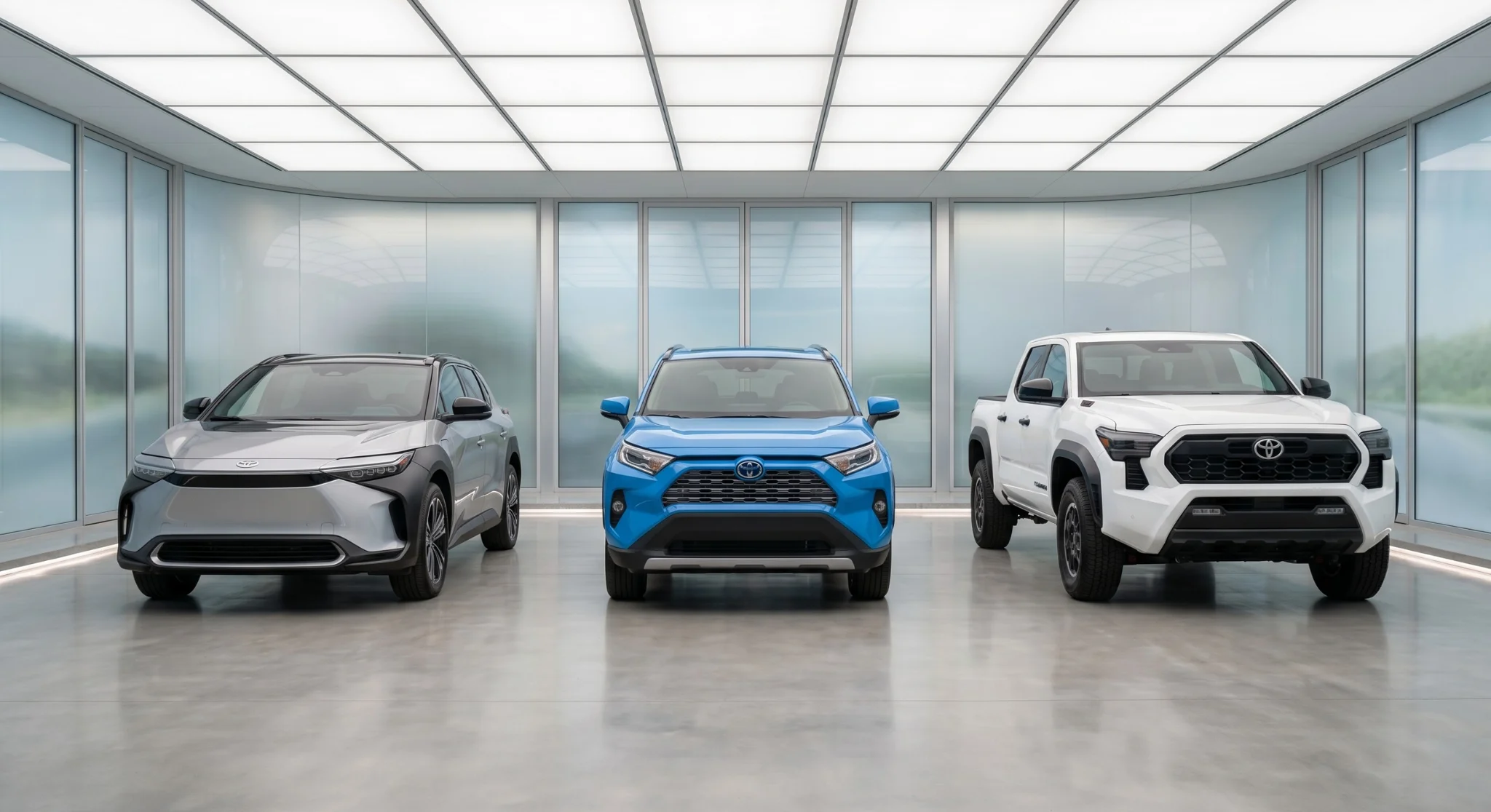
How a Hybrid Powertrain Works Compared to a Gas Engine
A gas engine and a hybrid system handle the same job — turning fuel into motion — in different ways. The table below breaks down the key mechanical differences, using the gas 2026 Nissan Rogue (1.5L VC-Turbo three-cylinder, 201 horsepower) and the 2026 Toyota RAV4 Hybrid (2.5L four-cylinder paired with an electric motor) as examples. Note that for 2026 the RAV4 is offered exclusively as a hybrid or plug-in hybrid — there is no longer a gas-only RAV4.
| Gas engine | Hybrid system | |
|---|---|---|
| How it makes power | Burns fuel through combustion alone | Combines a gas engine with an electric motor and a high-voltage battery |
| Energy when slowing down | Lost as heat through the brake pads | Regenerative braking captures it and stores it in the battery |
| At a stop or coasting | Engine keeps running | Gas engine can shut off; electric motor handles low-speed maneuvers |
| Driver involvement | None — conventional driving | None — the vehicle manages the hand-off automatically |
That stored energy is later used to assist the engine, which is how the RAV4 Hybrid reaches up to an EPA-Estimated 48 city / 42 highway mpg (LE FWD) against the gas Rogue’s EPA-Estimated 29 city / 36 highway mpg (FWD). To see the electrified side of the lineup, you can explore Toyota hybrids and EVs across the group, or browse the gas-powered lineup of new Nissan models.
Gas, Hybrid, and Electric at a Glance
| Gas (2026 Nissan Rogue) | Hybrid (2026 Toyota RAV4 Hybrid) | Electric (2026 Toyota bZ) | |
|---|---|---|---|
| Powertrain | 1.5L VC-Turbo I3, Xtronic CVT | 2.5L I4 + electric motor, CVT | Single or dual electric motor |
| Drivetrain | FWD; Intelligent AWD available | FWD or Electronic On-Demand AWD | FWD or AWD |
| Efficiency | EPA-Estimated 29 city / 36 hwy mpg (FWD) | EPA-Estimated up to 48 city / 42 hwy mpg (LE FWD) | EPA-Estimated up to 314-mile range (XLE FWD Plus) |
| Fueling | Gas pump, about 5 minutes | Gas pump, less often | Home or public charging |
EPA-estimated fuel economy figures are for comparison purposes only. Your actual mileage will vary depending on driving conditions, how you drive and maintain your vehicle, battery age/condition, and other factors.
Understanding EV Efficiency and MPGe
What MPGe Means
EV efficiency is measured in Miles Per Gallon equivalent (MPGe), an EPA metric that lets shoppers compare an EV’s energy use to a gas car’s. One gallon of gasoline contains about 33.7 kilowatt-hours (kWh) of energy, so an EV that travels 100 miles on 33.7 kWh is rated at 100 MPGe.
Why EVs Convert Energy More Efficiently
EVs convert stored energy to motion far more efficiently than combustion engines. The table below shows the general efficiency picture — though keep in mind that MPGe reflects energy efficiency, not operating cost, which depends on your local electricity rates.
| Measure | Gas vehicle | Electric vehicle |
|---|---|---|
| Energy converted to power at the wheels | Roughly 20% to 30% | Often more than 77% |
| Typical efficiency rating | About 30 to 33 mpg combined (compact SUV) | Commonly triple-digit MPGe |
| How it’s measured | Miles per gallon (mpg) | Miles per gallon equivalent (MPGe) |
Upfront Costs and Long-Term Value of Hybrids
Cost of Ownership Over Time
A frequent question is whether hybrid fuel savings justify a higher purchase price. Historically, hybrids carried a steep premium, but that gap has narrowed as the technology has scaled across the industry. Long-term value is also helped by reduced wear on some components: because regenerative braking does much of the slowing, friction brake pads and rotors often last longer than on a gas-only vehicle.
Toyota Warranty Coverage
Coverage matters too. The most complex parts of a hybrid’s dual-power system are backed by manufacturer warranties:
| Coverage | Term | What it covers |
|---|---|---|
| Powertrain | 60 months / 60,000 miles | Engine, transmission/transaxle, and drive systems |
| Hybrid (HV) battery (MY2020+) | 10 years / 150,000 miles* | The high-voltage battery in the dual-power system |
*Whichever comes first, from the date of first use.
This information is provided for general educational purposes only and does not constitute legal advice. Warranty coverage depends on the specific terms of your vehicle’s warranty agreement. Consult your owner’s manual or a qualified legal professional for guidance on your individual situation.
Charging and Fueling Economics for Southern California
Per-Mile Energy Costs
For Inland Empire commuters, energy cost matters. California gasoline prices are among the highest in the nation, which often makes electricity attractive on a per-mile basis. Charging an EV at home during off-peak hours is generally cheaper than filling a tank — in many cases roughly half the per-mile cost of a comparable gas vehicle, though this depends on your utility rate.
Charging Levels Explained
The most economical way to operate an EV is Level 2 home charging. Hybrid owners, by contrast, see no routine change — you fill the tank at any pump, just less often. Here’s how the charging options compare:
| Charging type | Outlet / source | Speed | Best for |
|---|---|---|---|
| Level 1 | Standard 120-volt household outlet | About 3 to 5 miles of range per hour | Very short daily commutes |
| Level 2 | 240-volt outlet (like an electric clothes dryer) | Typically a full charge overnight | Most home charging |
| DC fast charging | Public fast charger | About 10% to 80% in roughly 30 minutes* | Road trips and quick top-offs |
*Charging speed varies by vehicle and conditions.
What About Tax Credits and Incentives?
The incentive landscape changed significantly in 2026, so it’s worth understanding what’s current before you shop. The table below summarizes where the major programs stand, with sources linked for each item:
| Incentive | Status in 2026 | Notes | Source |
|---|---|---|---|
| Federal new-EV tax credit (up to $7,500) | Ended | Not available for vehicles acquired after September 30, 2025, under Public Law 119-21 (the One Big Beautiful Bill Act) | IRS; Congress.gov |
| Federal used-EV tax credit (up to $4,000) | Ended | Same September 30, 2025 cutoff under Public Law 119-21 | IRS; Congress.gov |
| California CVRP rebate | Closed | Closed to new applications effective November 8, 2023 | CARB |
| Clean Cars 4 All & DCAP (California) | Available, income-qualified | Amounts and eligibility vary by income, location, and funding status | CARB |
| Federal home EV-charger credit (30% of cost, up to $1,000) | Available, expiring | A separate credit under IRC Section 30C, among the energy provisions accelerated by Public Law 119-21; confirm the current cutoff with the IRS before claiming | IRS |
Because these programs change frequently, confirm current eligibility and amounts with the program administrator or a tax professional before purchasing.
Long-Distance Travel and Public Charging
Range and Refueling on a Road Trip
Modern battery technology and expanding charging networks have made EV road trips more feasible. Many new electric SUVs offer roughly 260 to 310 miles of range; the 2026 Toyota bZ is rated at an EPA-Estimated 314 miles (XLE FWD Plus). The table below compares what each powertrain means for longer drives:
| Gas | Hybrid | Electric | |
|---|---|---|---|
| Refueling on the road | About 5 minutes at any station | About 5 minutes at any station | About 30 minutes (10% to 80%) at a DC fast charger* |
| Total driving range | Long | Long (the RAV4 Hybrid offers extended total range) | EPA-Estimated up to 314 miles (2026 Toyota bZ, XLE FWD Plus) |
| Trip planning | Follow the highway | Follow the highway | Built-in route planning suggests charging stops |
*Charging speed varies by vehicle and conditions.
Which Suits Sparse-Charging Areas?
A hybrid like the RAV4 Hybrid offers a different kind of flexibility from an EV: a long total driving range and refueling in minutes at any station, which many drivers prefer when traveling where charging is sparse. Most EVs, meanwhile, include route planning that suggests charging stops based on remaining battery and nearby charger speed, which makes longer electric trips more predictable than they used to be.
Key Questions to Guide Your Next Purchase
Before deciding which powertrain belongs in your driveway, it helps to evaluate your daily habits. A short commute plus the ability to charge at home favors an EV’s low operating costs and smooth drive. Frequent towing or spontaneous long trips where charging is scarce favor a gas vehicle or a traditional hybrid. Feature priorities matter too: the Rogue offers a rugged Rock Creek trim with available Intelligent AWD, while the RAV4 Hybrid’s Woodland trim brings an outdoorsy focus with hybrid efficiency.
Which Powertrain Fits Your Driving?
| If you… | Consider | Why |
|---|---|---|
| Have a short commute and can charge at home | Electric | Lowest operating cost, quiet and smooth drive, zero tailpipe emissions |
| Want better efficiency with no change to your routine | Hybrid | Improved fuel economy, refuels in minutes, no charging required |
| Tow often or take long trips where charging is scarce | Gas or hybrid | Familiar five-minute refueling and long total driving range |
Common Questions About Hybrid and Electric Vehicles
A few of the questions we hear most often from shoppers weighing gas, hybrid, and electric options:
Do I need to plug in a standard hybrid like the RAV4 Hybrid?
No. Standard hybrids charge their battery through regenerative braking and by using the gasoline engine as a generator. You simply fuel up with gasoline like a traditional car, and the vehicle manages the electric assist automatically to improve your fuel economy.
How long do the batteries in electric and hybrid vehicles last?
Most modern hybrid and electric vehicle batteries are engineered to last roughly 100,000 to 150,000 miles, which for many drivers equates to about 8 to 15 years. Manufacturers provide significant warranty coverage as well — for example, Toyota covers the hybrid battery on model-year 2020 and newer vehicles for 10 years or 150,000 miles, whichever comes first.
Is maintenance more expensive for a hybrid because it has two power sources?
Often it’s the opposite for certain components. Because the electric motor assists with braking, the mechanical brakes experience less wear and tend to last longer. You still need regular oil changes for the gas engine, but these systems have proven reliable over long-term ownership.
Can I charge an electric vehicle using a standard 120-volt household outlet?
Yes — that’s known as Level 1 charging. It’s the slowest method, adding roughly 3 to 5 miles of range per hour, and it can work for drivers with very short daily commutes. For most EV owners, installing a 240-volt Level 2 charger at home is recommended so the vehicle can recharge fully overnight.
Finding Your Fit at OREMOR Automotive Group
Choosing between gas, hybrid, and electric is a meaningful step, and the best way to decide is a direct comparison. Across OREMOR Automotive Group’s rooftops you’ll find all three powertrains — from the fuel-sipping efficiency of a hybrid to the high-tech performance of a battery-electric SUV. To learn more about specific models, you can also explore our manufacturer research hub. When you’re ready, reach out to our team or browse the group’s current selection to see which models are available for a test drive. You can call us at 909-323-0539 to get started.
This content is provided for general informational purposes only and does not constitute financial, tax, or legal advice. Pricing, incentives, availability, and program eligibility are subject to change. Please confirm current details with the dealership and consult a qualified professional regarding your individual situation.