

Lexus vs. BMW vs. Mercedes-Benz: Comparing the Luxury Leaders
For luxury SUV shoppers, the decision often comes down to three names: Lexus, BMW, and Mercedes-Benz. Each brand chases a different ideal — Lexus for long-term dependability and serenity, BMW for driver engagement, and Mercedes-Benz for technology and prestige. Because OREMOR Automotive Group carries all three, you can compare them honestly and shop whichever one wins you over. Below, we put the three best-selling midsize luxury SUVs — the Lexus RX 350, BMW X5, and Mercedes-Benz GLE 350 — head to head.
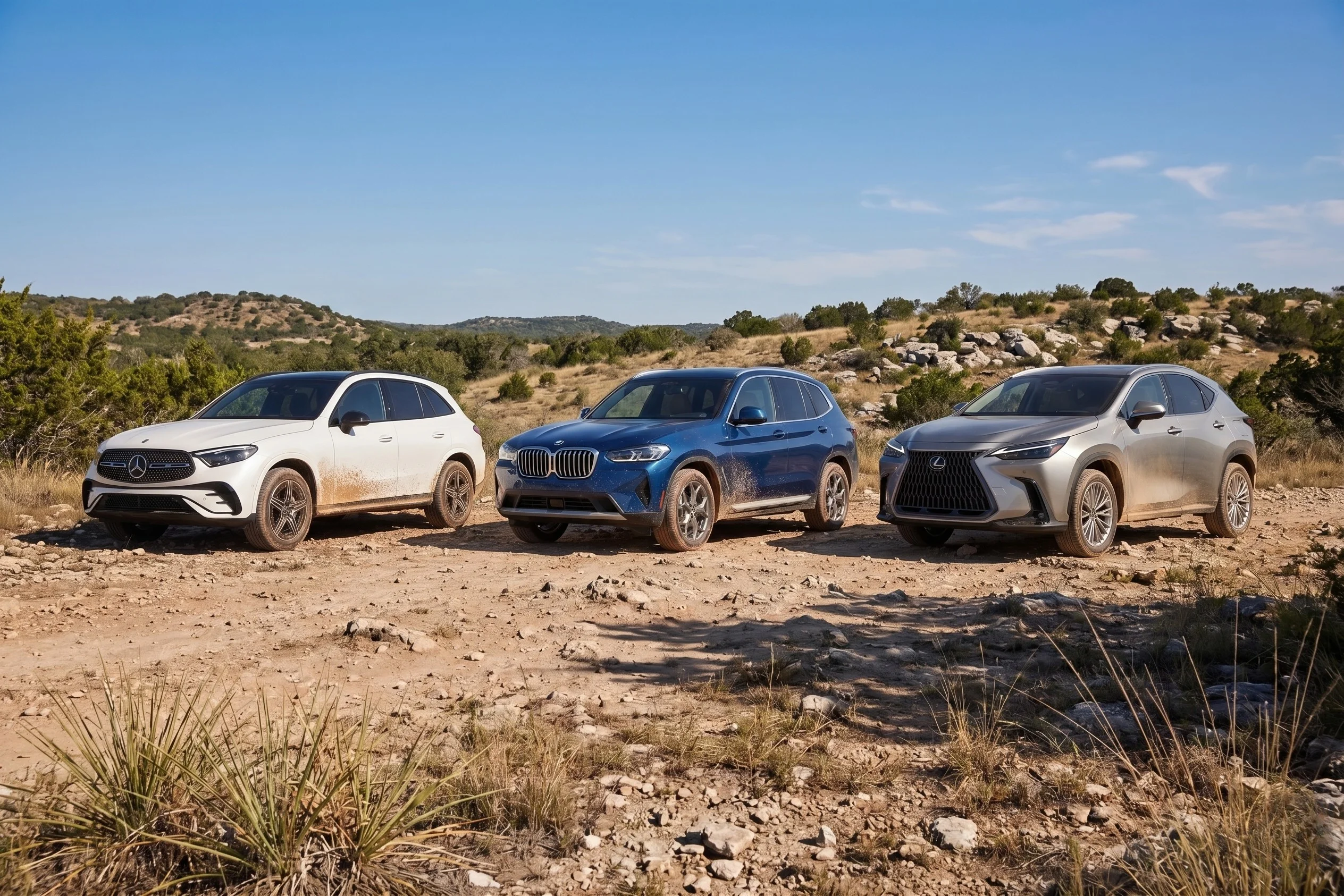
RX 350 vs. X5 vs. GLE 350: Specs Head to Head
Each of these SUVs anchors its brand’s midsize lineup, but they take different routes to luxury. The Lexus RX 350 leads on price and efficiency, the BMW X5 brings the most power and the sportiest character, and the Mercedes-Benz GLE 350 splits the difference with available three-row seating. The table below compares each model’s entry trim.
| Spec (Base Trim) | 2026 Lexus RX 350 | 2026 BMW X5 (sDrive40i) | 2026 Mercedes-Benz GLE 350 |
|---|---|---|---|
| Engine | 2.4L turbocharged I4 | 3.0L turbocharged I6 mild hybrid | 2.0L turbocharged I4 mild hybrid |
| Horsepower | 275 hp / 317 lb-ft | 375 hp / 398 lb-ft | 255 hp |
| Transmission | 8-speed automatic | 8-speed automatic | 9-speed automatic |
| Standard Drivetrain | FWD (AWD available) | RWD (AWD available) | RWD (4MATIC AWD available) |
| EPA MPG (base, city/hwy) | 22 / 29 | 23 / 27 | 21 / 28 |
| Seating | 5 | 5 | 5 (3rd row available) |
| Starting MSRP | ~$50,825 | ~$69,750 | ~$63,600 |
MSRP on new inventory covers manufacturer-provided equipment and distributor logistics fees, all of which remain subject to revision. This amount does not account for taxes, registration, dealer-installed additions, or other local charges. MSRP is not a retail advertisement; actual dealer pricing will vary. The dealer sets the final price.
Performance and Driving Character
The driving experience tracks each brand’s philosophy. The 2026 Lexus RX 350 pairs its 2.4-liter turbocharged inline-four (275 horsepower, 317 lb-ft) with an eight-speed automatic, tuned for smooth, quiet response rather than outright aggression — front-wheel drive is standard and all-wheel drive is available across the lineup. The BMW X5 is the segment’s handling benchmark: its 375-horsepower turbocharged inline-six is the most powerful base engine of the three, paired with rear-biased dynamics, communicative steering, and available adaptive air suspension for genuine corner agility. The Mercedes-Benz GLE 350 sits in between, with a 255-horsepower turbocharged four and a focus on a cushioned, isolated ride; its available AIRMATIC air suspension smooths road imperfections for a composed, refined feel.
For drivers who want more, each brand offers far more potent variants — BMW’s M models, Mercedes-AMG, and the Lexus RX 500h F SPORT Performance hybrid — but in their core trims, the RX prioritizes effortless quiet, the X5 prioritizes engagement, and the GLE prioritizes comfort. You can dig deeper into the Lexus contender in our 2026 Lexus RX 350 review.
Technology and Interior
All three deliver premium cabins with large digital displays, wireless smartphone integration, and configurable driver displays. Mercedes-Benz is widely regarded as the technology and interior leader of the group, known for pioneering expansive digital displays and richly appointed materials. BMW’s cabin pairs a wide curved display with its latest iDrive interface and a sport-focused, driver-angled layout. Lexus centers its interior on omotenashi — the Japanese spirit of hospitality — emphasizing cabin serenity, soft-touch materials, and intuitive controls over flash. The GLE 350 also offers an available third row, giving it a practicality edge for larger families, while the RX and X5 are strictly five-seaters.
Reliability: Where Lexus Leads
Reliability is where Lexus has built its reputation. In the J.D. Power 2026 U.S. Vehicle Dependability Study — which measures problems per 100 vehicles (PP100) after three years of ownership — Lexus ranked highest overall, and highest among luxury brands, for the fourth consecutive year with a score of 151 PP100, well ahead of the industry average of 204 PP100. The Lexus IS was named the study’s Most Dependable Model overall. A lower score is better.
Part of the explanation is engineering philosophy. Lexus shares core platforms and components with the broader Toyota family, which simplifies parts availability and long-term maintenance. BMW and Mercedes-Benz tend to introduce cutting-edge powertrain and electronics technology earlier, which delivers high performance but can require more specialized attention once the warranty period ends. J.D. Power’s study also notes that smartphone integration and infotainment remain the industry’s most common problem areas across all brands.
Cost of Ownership: Maintenance and Warranty
The cost of luxury ownership extends well past the sticker price. According to RepairPal, the average annual maintenance and repair cost runs about $551 for Lexus, $968 for BMW, and $908 for Mercedes-Benz — a meaningful gap that compounds over years of ownership.
| Brand | Average Annual Maintenance & Repair (RepairPal) |
|---|---|
| Lexus | $551 |
| BMW | $968 |
| Mercedes-Benz | $908 |
Warranty coverage adds another layer of financial protection, and the three brands take different approaches. All three offer the same 4-year/50,000-mile basic (bumper-to-bumper) coverage. The key difference is powertrain protection: Lexus extends powertrain coverage to 6 years/70,000 miles, two years and 20,000 miles longer than both BMW and Mercedes-Benz, which tie powertrain coverage to the same 4-year/50,000-mile window as their basic warranties. BMW counters with the longest rust-perforation coverage (12 years/unlimited miles) and includes 3 years/36,000 miles of complimentary scheduled maintenance through BMW Ultimate Care, while Lexus offers the longest roadside assistance term at 48 months regardless of mileage. For buyers who keep a vehicle five years or more, Lexus’s longer powertrain coverage can offset significant out-of-pocket costs.
| Coverage | Lexus | BMW | Mercedes-Benz |
|---|---|---|---|
| Basic (Bumper-to-Bumper) | 4 yr / 50,000 mi | 4 yr / 50,000 mi | 4 yr / 50,000 mi |
| Powertrain | 6 yr / 70,000 mi | 4 yr / 50,000 mi | 4 yr / 50,000 mi |
| Corrosion / Rust Perforation | 6 yr / unlimited mi | 12 yr / unlimited mi | 4 yr / 50,000 mi |
| Roadside Assistance | 48 mo / unlimited mi | Duration of basic warranty | Duration of basic warranty |
| Complimentary Scheduled Maintenance | 1st & 2nd services (1 yr / 10,000 mi) | 3 yr / 36,000 mi (Ultimate Care) | Not included — Prepaid Maintenance plans available |
Warranty terms are summarized from manufacturer materials and are current as of June 2026. Coverage details, durations, and exclusions vary by model, model year, and region, and are subject to change. Hybrid/EV high-voltage battery and emissions components carry separate coverage. This comparison is for general informational purposes only — confirm current terms with the manufacturer or an authorized dealer before purchase.
Brand Reputations and Design Philosophies
Each brand targets a distinct buyer. Lexus centers its identity on cabin serenity and ergonomic ease, with a lineup defined by the brand’s spindle design language and sharp, angular lines. BMW pursues “the Ultimate Driving Machine,” with firmer suspension tuning, a driver-focused cockpit, and muscular surfacing built around its signature kidney grille. Mercedes-Benz leans into prestige and pioneering interior technology, pairing a smoother, more aerodynamic “sensual purity” design with the most opulent cabins in the group. Refinement, athleticism, and presence — three different answers to the same luxury question.
The Verdict: Which One Wins?
There’s no single winner — the right choice depends on what you value most. Here’s how the three sort out by priority:
| If You Prioritize… | Best Pick | Why |
|---|---|---|
| Reliability & cost of ownership | Lexus RX 350 | #1 in J.D. Power dependability for the fourth straight year, lowest maintenance costs, and the longest powertrain warranty. |
| Performance & handling | BMW X5 | The most powerful base engine (375 hp) and the sharpest, most engaging driving dynamics in the group. |
| Technology, interior & space | Mercedes-Benz GLE 350 | Class-leading cabin technology and materials, plus an available third row the RX and X5 don’t offer. |
| Value & efficiency | Lexus RX 350 | The lowest starting MSRP of the three and strong fuel economy, without sacrificing luxury. |
Frequently Asked Questions
Which luxury brand is the most reliable — Lexus, BMW, or Mercedes-Benz?
Lexus ranks highest in this group. It placed first overall in the J.D. Power 2026 U.S. Vehicle Dependability Study for the fourth consecutive year, with 151 PP100 versus an industry average of 204. BMW and Mercedes-Benz have improved their manufacturing but still tend to report more issues with complex electronics and powertrain components after the first three years.
Which has the most power — the RX 350, X5, or GLE 350?
The BMW X5 sDrive40i leads with 375 horsepower from its turbocharged inline-six. The Lexus RX 350 produces 275 horsepower from a turbocharged four, and the Mercedes-Benz GLE 350 makes 255 horsepower from its turbocharged four. For higher output, all three brands offer more powerful trims.
Which is the most affordable to buy?
The Lexus RX 350 has the lowest starting MSRP of the three at around $50,825, compared with roughly $69,750 for the BMW X5 and about $63,600 for the Mercedes-Benz GLE 350 (all including destination). Final pricing varies by configuration and dealer.
Which brand offers the best performance and handling?
BMW generally delivers the most engaging drive, with sharper steering and cornering. Mercedes-Benz prioritizes ride comfort and isolation, while Lexus focuses on refinement and smooth power delivery — the most relaxing of the three in heavy traffic.
Do Lexus models cost less to maintain than German rivals?
On average, yes. RepairPal estimates about $551 per year for Lexus versus $968 for BMW and $908 for Mercedes-Benz, driven largely by simpler, Toyota-derived mechanicals and longer service intervals.
Does Lexus use the same parts as Toyota?
Lexus shares several core platforms and engine components with Toyota. That shared architecture is a primary reason for its strong reliability and lower maintenance costs, and it simplifies access to service and replacement parts compared with specialized German components.
Find Your Next Luxury SUV at OREMOR Automotive Group
Choosing between Lexus, BMW, and Mercedes-Benz comes down to your priorities. If you value a low-stress ownership experience with lower maintenance costs and class-leading reliability, the Lexus RX is the strongest contender. If you prioritize driving dynamics, the BMW X5 leads; if you want the most advanced cabin and available third-row space, the Mercedes-Benz GLE makes a compelling case. The best way to decide is to drive all three on a route that mixes city traffic with highway speeds. Because OREMOR carries all three brands, you can shop each one directly.
MSRP on new inventory covers manufacturer-provided equipment and distributor logistics fees, all of which remain subject to revision. This amount does not account for taxes, registration, dealer-installed additions, or other local charges. MSRP is not a retail advertisement; actual dealer pricing will vary. The dealer sets the final price.