

Toyota vs. Lexus: How Two Toyota-Built Brands Compare — and Why OREMOR Has Both
OREMOR Automotive Group · 1377 Kettering Dr., Ontario, CA 91761 · 909-323-0539
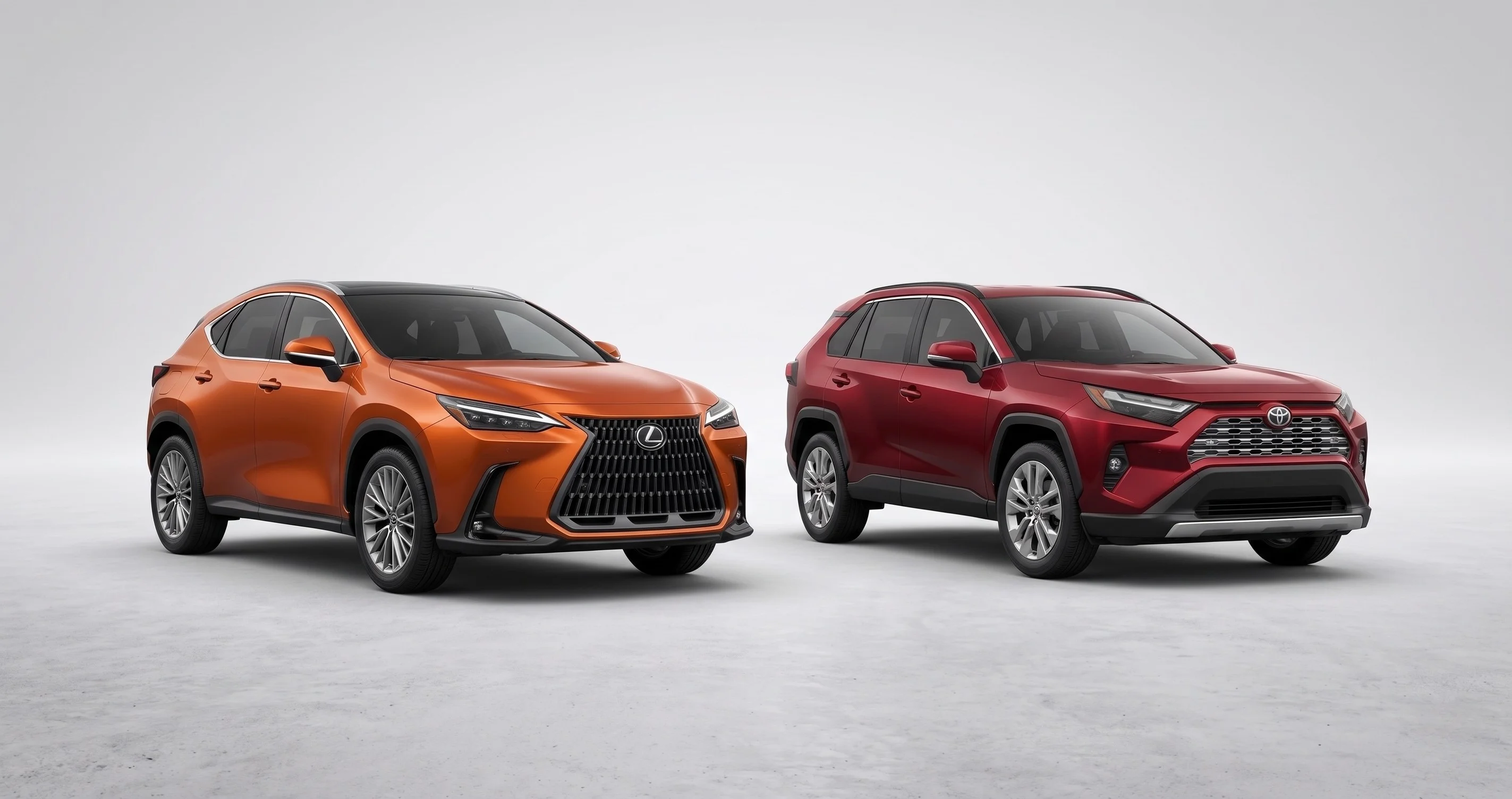
Toyota and Lexus share an engineering foundation but pursue two different philosophies. Both are built by Toyota Motor Corporation, and once a basic platform is set, their priorities diverge. Toyota emphasizes broad utility and value — a vehicle like the 2026 Toyota Highlander is built to serve as a dependable family three-row that seats up to eight on its XLE and Limited trims. Lexus takes shared architecture as a starting point for added refinement: extra sound insulation, upgraded materials, and unique tuning aimed at a quieter, more isolated cabin.
That shared DNA is real. The 2026 Lexus RX 350 and the 2026 Toyota Highlander both use a 2.4-liter turbocharged four-cylinder engine — the RX 350 tuned to 275 horsepower on premium fuel, the Highlander producing 265 horsepower and 310 lb-ft on regular unleaded. At the larger end, the Toyota Grand Highlander and the Lexus TX are built on the same TNGA-K platform, with the Lexus version adding a more isolated cabin and upgraded interior appointments.
Here’s what makes this comparison unusual: OREMOR Automotive Group sells both brands. Across our rooftops you’ll find multiple Toyota stores and multiple Lexus stores throughout Southern California and Texas — so whichever way you lean, our team can put you in the right vehicle. If you’re weighing other badges too, see our Toyota vs Nissan comparison or our Lexus vs Acura comparison.
Toyota vs. Lexus at a Glance
Using two closely related models — the 2026 Toyota Highlander and the 2026 Lexus RX 350 — here’s how the mainstream and luxury approaches line up.
| Attribute | Toyota — 2026 Highlander | Lexus — 2026 RX 350 |
|---|---|---|
| Starting Price | From about $47,365 TSRP | From about $50,825 MSRP |
| Engine | 2.4L turbo I4 — 265 hp / 310 lb-ft | 2.4L turbo I4 — 275 hp |
| Fuel | Regular unleaded (Hybrid: up to EPA-estimated 35 mpg combined) | Premium (91 octane) |
| Max Seating | Up to 8 (XLE / Limited) | 5 |
| Brand Positioning | Mainstream value & utility | Luxury refinement & cabin isolation |
Reliability & Dependability
“Is Lexus more reliable than Toyota?” is a question we hear often, and the data places both brands among the most dependable in the industry. Lexus leads, but Toyota also performs well ahead of the industry average.
| J.D. Power Study | Toyota | Lexus |
|---|---|---|
| 2026 Vehicle Dependability Study (VDS) | 185 PP100 (vs. 204 industry avg.) | #1 overall — 151 PP100 |
| 2025 Initial Quality Study (IQS) | Above industry average | #1 overall — 166 PP100 |
In the J.D. Power 2026 U.S. Vehicle Dependability Study, Lexus ranked #1 overall (151 problems per 100 vehicles) for the fourth straight year, while Toyota scored 185 PP100 — both better than the 204 PP100 industry average. Lexus also ranked #1 overall (166 PP100) in the J.D. Power 2025 U.S. Initial Quality Study, the most recent edition of that separate study (the Initial Quality Study is released later in the year, so the 2026 edition was not yet published as of this writing). Both brands are known for long-haul durability, with many owners reporting well over 200,000 miles of service with consistent maintenance. (Source: J.D. Power 2026 U.S. Vehicle Dependability Study and 2025 U.S. Initial Quality Study, jdpower.com. J.D. Power scores are problems per 100 vehicles; lower is better.)
Warranty Coverage
Warranty terms track each brand’s positioning, and Lexus adds complimentary early maintenance.
| Coverage | Toyota (2026 Highlander) | Lexus (2026 RX) |
|---|---|---|
| Basic (Bumper-to-Bumper) | 3 years / 36,000 miles | 4 years / 50,000 miles |
| Powertrain | 5 years / 60,000 miles | 6 years / 70,000 miles |
Every new Lexus also includes its first and second scheduled maintenance services (at 6 months/5,000 miles and 12 months/10,000 miles). Warranty terms are summarized for general comparison only — see the warranty disclaimer at the bottom of this page.
Comfort, Cabin & Daily Driving
Lexus models are engineered to isolate occupants from the road, using extensive sound-dampening materials not typically found in mainstream vehicles. The 2026 RX front seats use supportive bolsters and high-grade leather built for fatigue reduction on long commutes. The all-new 2026 Lexus ES showcases the brand’s tech direction with a 14.0-inch central touchscreen running the latest Lexus Interface, paired with a 12.3-inch digital driver display.
Toyota tunes its vehicles for a more communicative, utilitarian ride. The Highlander’s suspension is set up for everyday family duty, and the 2026 Toyota Land Cruiser — built on the rugged TNGA-F platform with the i-FORCE MAX hybrid powertrain (326 hp) — is engineered for genuine off-road capability rather than the cosseting ride of a luxury SUV.
On safety, both brands carry comprehensive standard driver-assistance suites. Toyota’s Safety Sense 3.0 includes a Pre-Collision System designed to detect vehicles, pedestrians, cyclists, and motorcyclists. Lexus integrates comparable technology into a more premium cabin environment, with the 2026 ES debuting Lexus Safety System+ 4.0.
Pricing, Depreciation & Resale Value
The price gap between a Toyota and a comparable Lexus reflects differences in standard features and materials.
| 2026 Model | Starting Price |
|---|---|
| Toyota Highlander (XLE) | From about $47,365 TSRP |
| Lexus RX 350 | From about $50,825 MSRP |
| Toyota Land Cruiser (1958) | $57,200 TSRP |
Pricing varies by trim, options, and market — contact our team for current figures on any specific configuration. See the TSRP and MSRP disclaimers at the bottom of this page.
Both brands are resale-value leaders. In Kelley Blue Book’s 2026 Best Resale Value Awards, Toyota was again named Best Resale Value: Brand (its sixth consecutive win) and Lexus took Best Resale Value: Luxury Brand (its fifth consecutive win). Even though a Lexus costs more up front, both brands are projected to retain a strong share of their value over five years. (Source: Kelley Blue Book 2026 Best Resale Value Awards, kbb.com.)
On fuel, the 2026 Lexus RX 350’s 2.4-liter turbo uses premium fuel to reach its 275-hp rating, while the 2026 Toyota Highlander Hybrid is rated at up to an EPA-estimated 35 mpg combined on regular unleaded — so a Toyota hybrid’s fuel savings can offset part of its purchase price over time. See the fuel economy disclaimer at the bottom of this page.
California Fees & Registration Basics
Buying in California involves state fees that apply to any brand. The Vehicle License Fee (VLF) is 0.65% of the vehicle’s value, so a more expensive Lexus carries a higher VLF than a comparably positioned Toyota. California also assesses a tiered Transportation Improvement Fee based on vehicle value, plus a $118 annual Road Improvement Fee on model-year-2020-and-later zero-emission vehicles (assessed at renewal). For an exact estimate on a specific trim, we recommend the California DMV fee calculator. (Source: California DMV registration fee information, dmv.ca.gov; fee figures current as of 2026.)
Common Questions About Toyota and Lexus
Does the Lexus NX require premium fuel?
The 2026 Lexus NX 350 (2.4-liter turbo) and NX 450h+ plug-in hybrid are engineered to run on 91-octane premium fuel for their rated performance. Lower-octane fuel can reduce output and efficiency.
Is Lexus more reliable than Toyota?
Both are industry leaders. Lexus took the top overall spot in the J.D. Power 2026 Vehicle Dependability Study (151 PP100) and in the 2025 Initial Quality Study (the most recent edition of that separate study), while Toyota also scored better than the industry average for dependability. (Source: J.D. Power, jdpower.com.)
Do Lexus and Toyota share the same parts?
Many mechanical components — engines, transmissions, and platforms — are shared between specific models (for example, the Grand Highlander and Lexus TX share the TNGA-K platform). Lexus typically adds sound-dampening materials and higher-grade finishes not offered on the Toyota counterpart.
Does a Lexus cost more to maintain than a Toyota?
Maintenance generally runs higher for a Lexus due to premium fluids, specialized parts, and luxury labor rates. That said, every new Lexus includes its first two scheduled maintenance visits.
Which brand has better resale value?
In Kelley Blue Book’s 2026 awards, Toyota holds Best Resale Value: Brand and Lexus holds Best Resale Value: Luxury Brand — so both protect against depreciation better than most competitors. (Source: Kelley Blue Book, kbb.com.)
Find Your Match at OREMOR
Choosing between Toyota’s value-driven utility and Lexus’s refined comfort comes down to your priorities. Want maximum family practicality and a strong value story? The Toyota lineup — including the up-to-eight-passenger Highlander — delivers. Want a quieter cabin, premium materials, and a longer powertrain warranty? The Lexus RX makes the case.
Because OREMOR Automotive Group carries both brands across multiple Toyota and Lexus locations, you don’t have to choose a dealership before you choose a vehicle. Explore more brand comparisons, or jump straight to inventory below.
Disclaimers
Fuel Economy: EPA-estimated fuel economy figures are for comparison purposes only. Your actual mileage will vary depending on driving conditions, how you drive and maintain your vehicle, battery age/condition, and other factors.
TSRP (Toyota): TSRP on new inventory covers manufacturer/distributor equipment and logistics fees, all of which are subject to revision. It does not account for taxes, registration, dealer-installed additions, or other local charges. TSRP is not a retail advertisement; actual dealer pricing will vary. The dealer sets the final price.
MSRP (Lexus): MSRP on new inventory covers manufacturer-provided equipment and distributor logistics fees, all of which remain subject to revision. This amount does not account for taxes, registration, dealer-installed additions, or other local charges. MSRP is not a retail advertisement; actual dealer pricing will vary. The dealer sets the final price.
Warranty: Warranty coverage shown is a general summary of manufacturer new-vehicle limited warranties and is provided for comparison purposes only. Coverage terms, exclusions, and conditions are subject to change and vary by model, model year, and powertrain. See the manufacturer’s official warranty and maintenance guide and your dealer for complete details.
Pricing & Data: Specifications, pricing, awards, and ratings referenced are subject to change and were current as of the date of publication. Vehicle specifications and pricing should be confirmed with the dealer prior to purchase.