

Mercedes-Benz Sprinter Cargo vs. Crew vs. Passenger: How to Choose the Right Van
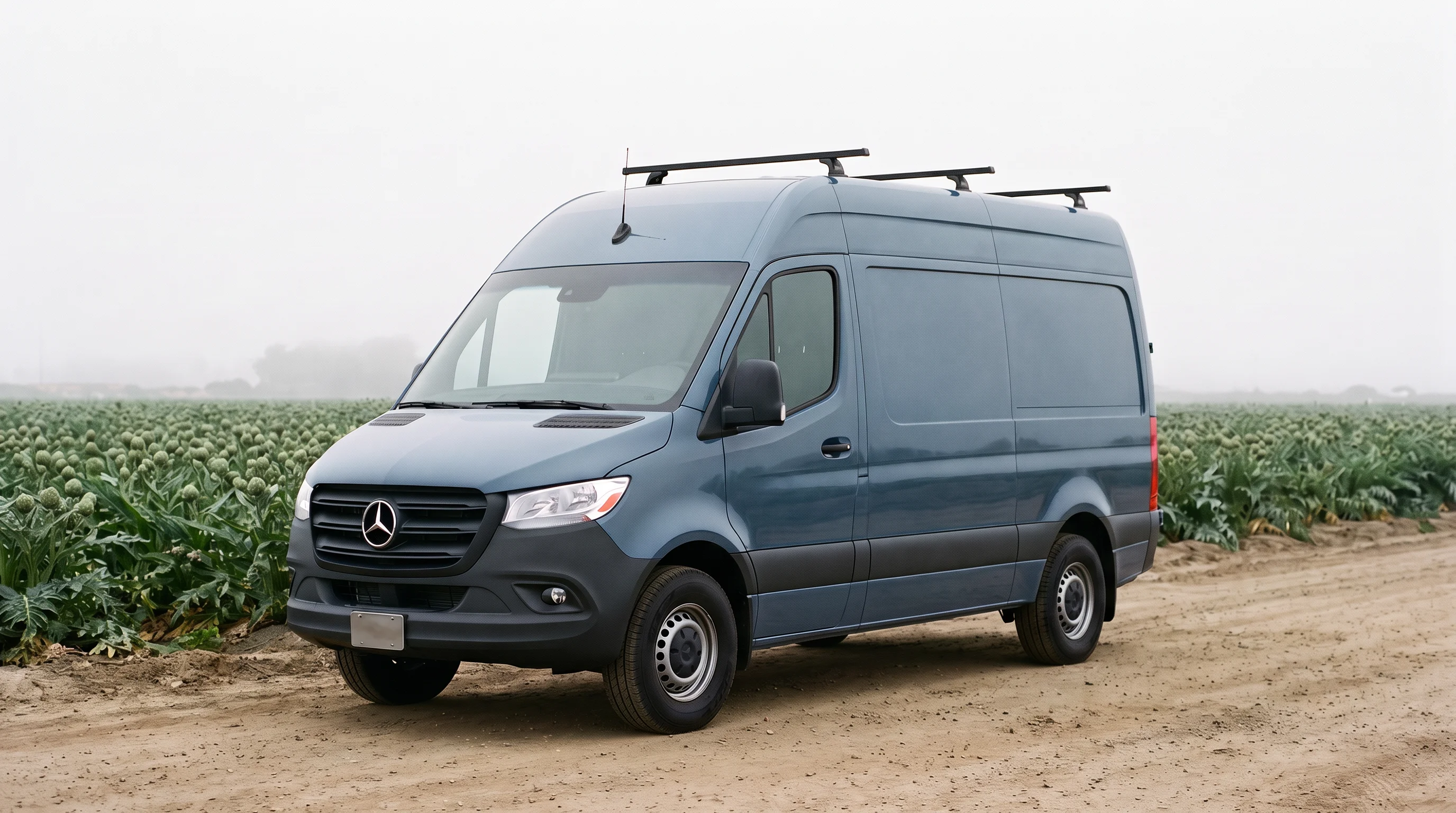
The difference between the Mercedes-Benz Sprinter Cargo, Crew, and Passenger van comes down to three things: how many people sit in it, how much glass is in the sides, and what the rear of the body is built to hold. Cargo vans seat two or three up front behind solid sheet-metal walls. Crew vans seat up to five across two rows and keep a dedicated cargo area behind them. Passenger vans carry up to 15 people with glass running the length of both sides.
For fleet operators and van builders, picking the right body from the factory is cheaper than modifying the wrong one later — and it is the only way to get factory-engineered seating, glass, and climate equipment instead of aftermarket substitutes.
How the Three Body Styles Compare
Sprinter Cargo Van
Pure utility. No rear seats, no rear glass, and unobstructed sheet-metal walls built for shelving, trade racks, or a camper conversion. It carries the highest payload of the three because it carries none of the weight the other two add, and it is the only one of the three that scales past the 2500 chassis into the 3500, 3500XD, and 4500 series.§
Sprinter Crew Van
The middle ground. A removable three-seat bench sits in the second row with factory glass alongside it, and a driver-compartment partition is available. Behind that row, the cargo area stays separate from the cabin — the reason it works for crews that haul people and materials on the same run.
Sprinter Passenger Van
Built for group transport only — 12 passengers on the 144-inch wheelbase, 15 on the 170-inch, with full side glass down both sides and standard front and rear air conditioning.
| Specification | Cargo Van | Crew Van | Passenger Van |
|---|---|---|---|
| Seating capacity | 2–3 | Up to 5 | Up to 15 |
| Side glass | None (solid panels) | Second row only | Full length, both sides |
| Chassis series offered | 2500, 3500, 3500XD, 4500 | 2500 only | 2500 only |
| Wheelbase options | 144″, 170″, 170″ extended | 144″, 170″ | 144″, 170″ |
| Roof heights | Standard or high | Standard or high | Standard or high |
| Max cargo volume | 533 cu ft | 396 cu ft | 117 cu ft |
| Max interior standing height | 79 in | 77 in | 76 in |
| Max payload§ | 6,812 lbs | 3,825 lbs | 3,307 lbs |
| Max towing§ | 7,500 lbs | 5,000 lbs | 5,000 lbs (12-seater only) |
§ Maximum towing and payload capacity figures are based on properly equipped vehicles and vary by configuration. Do not exceed any weight rating. See your owner’s manual and the vehicle’s door-jamb label for specific capacities.
Cited Source: Mercedes-Benz Vans — 2026 Sprinter lineup, body configurations, and capacity specifications
Interior Room by Body Style and Configuration
Cargo volume is where the three bodies separate hardest, and each one changes again with wheelbase and roof height. The Cargo Van spans the widest range. The Crew Van gives up roughly a quarter of that volume to its second row. The Passenger Van, with seats filling the body, measures its space behind the last row rather than across the whole floor.
| Body style | Configuration | Cargo volume |
|---|---|---|
| Cargo Van 2500 | 144″ wheelbase, standard roof | 319 cu ft |
| Cargo Van 2500 | 144″ wheelbase, high roof | 374 cu ft |
| Cargo Van 2500 | 170″ wheelbase, high roof | 488 cu ft |
| Cargo Van 2500 | 170″ extended wheelbase, high roof | 533 cu ft |
| Crew Van 2500 | 144″ wheelbase, standard roof | 240 cu ft |
| Crew Van 2500 | 144″ wheelbase, high roof | 279 cu ft |
| Crew Van 2500 | 170″ wheelbase, high roof | 396 cu ft |
| Passenger Van 2500 (12-passenger) | 144″ wheelbase, standard roof | 70 cu ft |
| Passenger Van 2500 (12-passenger) | 144″ wheelbase, high roof | 82 cu ft |
| Passenger Van 2500 (15-passenger) | 170″ wheelbase, high roof | 117 cu ft |
Floor length follows the same pattern: the Cargo Van stretches to 189 inches of cargo floor on the 170-inch extended body, while the Crew Van tops out at 144 inches behind its second row.
Roof height is the second lever, and it applies to all three bodies. Standard-roof models give about 68 inches of interior standing height in the Cargo Van, low enough to clear most parking structures. High-roof models open that to roughly 79 inches — enough for a six-foot technician to stand fully upright inside.
Cited Source: Mercedes-Benz Vans — Sprinter Cargo Van | Sprinter Crew Van | Sprinter Passenger Van — 2026 interior dimensions and cargo volume by configuration
Rear Climate Control Is the Equipment Split That Catches Buyers Out
This is the one difference between Crew and Passenger that gets missed at order time. Passenger Vans come with standard front and rear air conditioning, with roof-mounted rear units offered in two output levels including a high-performance version. On a Crew Van, rear climate equipment is optional.
If the plan is carrying a crew in the second row through a Southern California summer, confirm rear climate is specified on the Crew Van build sheet before the order goes in. It is not something to discover after delivery.
Cited Source: Mercedes-Benz Vans — Sprinter Passenger Van | Sprinter Crew Van — 2026 standard and optional climate equipment
Towing Is Capped by the Chassis, Not the Engine
Here is the detail most Sprinter shoppers get wrong, and it maps directly onto the body-style choice. The 7,500-lb tow rating belongs to the heavier Cargo chassis classes. Crew Vans and Passenger Vans are built on the 2500 chassis only, which means both are rated at 5,000 lbs — and ordering the high-output engine does not change that.§
So if the trailer needs more than 5,000 lbs behind it, the body-style decision is already made for you. You need a Cargo Van.
§ Maximum towing and payload capacity figures are based on properly equipped vehicles and vary by configuration. Do not exceed any weight rating. See your owner’s manual and the vehicle’s door-jamb label for specific capacities.
Cited Source: Mercedes-Benz Vans — 2026 Sprinter towing ratings by model and chassis series | Jalopnik — Sprinter towing capacity breakdown
Three Bodies Is Not the Whole Lineup
If none of the three main bodies fits, the Sprinter range runs wider. The Passenger Van Select is a higher-appointed version of the passenger body. The Cab Chassis/Cutaway arrives as a bare frame in 3500XD and 4500 series for upfitters building boxes, service bodies, or RVs. And the eSprinter Cargo Van covers the same cargo mission on an all-electric drivetrain.
Cited Source: Mercedes-Benz Vans — current Sprinter and eSprinter lineup
Why Builders Start Conversions With a Cargo Van
If the plan is a camper build or a temperature-controlled mobile workstation, the Cargo Van is the easier starting point. With no rear seats and no rear glass, the body gives you continuous sheet-metal wall from floor to ceiling and nothing to work around.
A Crew Van hands you two obstacles instead. The factory glass alongside the second row cannot be insulated, so it stays a thermal weak point no matter what goes into the walls below it. And the second-row bench, its mounting points, and its belt structures occupy wall and floor space that a Cargo Van leaves open.
The tradeoff runs both ways. If you need factory rear seating with factory-engineered restraints, the extra conversion work on a Crew Van is simply the price of getting it.
Cited Source: Mercedes-Benz Vans — Sprinter Crew Van — 2026 second-row seating and body glass configuration
Matching the Body Style to the Job
| What the van has to do | Body style | The deciding factor |
|---|---|---|
| Haul only, at maximum capacity | Cargo Van | The only one of the three van bodies that reaches 6,812 lbs of payload or 7,500 lbs of towing§ |
| Carry people and gear on the same run | Crew Van | Five seats plus a separate cargo hold, and a bench that unbolts when you need the floor back |
| Move groups | Passenger Van | Twelve or 15 seats with rear climate control included rather than optioned |
| Build a camper or a custom interior | Cargo Van | Continuous sheet-metal walls with no glass or seat structures to work around |
§ Maximum towing and payload capacity figures are based on properly equipped vehicles and vary by configuration. Do not exceed any weight rating. See your owner’s manual and the vehicle’s door-jamb label for specific capacities.
Cited Source: Mercedes-Benz Vans — 2026 Sprinter payload, towing, and seating by body style
Start by deciding whether the job is cargo, passengers, or both, then work outward to wheelbase and roof height. OREMOR Automotive Group’s Sprinter inventory lives at Mercedes-Benz of El Cajon, serving commercial buyers across San Diego, La Mesa, and Chula Vista.
Cross-shopping other Mercedes-Benz models? Read our 2026 BMW X1 vs. Mercedes-Benz GLA comparison.
Common Questions About Sprinter Body Styles
Can rear seating be added to a Sprinter Cargo Van after purchase?
It can be done through a certified upfitter, but buying a factory Crew or Passenger Van is generally more cost-effective and is the only route that guarantees factory safety-system integration on the seating structure.
Does the Sprinter Crew Van include rear air conditioning as standard?
No. Rear climate control with dedicated ducting is standard on Passenger Vans and optional on Crew Vans. Confirm it is specified on the build sheet.
How much can a Mercedes-Benz Sprinter tow?
Up to 7,500 lbs on a properly equipped Cargo Van in the 3500, 3500XD, or 4500 series. All 2500-series models, including every Crew and Passenger Van, are rated at 5,000 lbs.§
§ Maximum towing and payload capacity figures are based on properly equipped vehicles and vary by configuration. Do not exceed any weight rating. See your owner’s manual and the vehicle’s door-jamb label for specific capacities.
Are side windows standard on every Sprinter?
No. Passenger Vans have glass down both sides. Crew Vans have glass at the second-row seating area. Cargo Vans use solid sheet-metal side panels.
Cited Source: Mercedes-Benz Vans — 2026 Sprinter towing ratings, climate equipment, and body glass by model
Disclaimers
§ Maximum towing and payload capacity figures are based on properly equipped vehicles and vary by configuration. Do not exceed any weight rating. See your owner’s manual and the vehicle’s door-jamb label for specific capacities.
Cited Sources
Mercedes-Benz Vans — Sprinter — 2026 lineup, body configurations, payload, towing, and capacity specifications
Mercedes-Benz Vans — Sprinter Cargo Van — 2026 cargo volume, floor length, and standing height by configuration
Mercedes-Benz Vans — Sprinter Crew Van — 2026 seating, second-row glass, cargo volume, and climate equipment
Mercedes-Benz Vans — Sprinter Passenger Van — 2026 seating capacity, cargo volume, and standard front and rear air conditioning
Jalopnik — Sprinter towing capacity breakdown by model and chassis series







0 comment(s) so far on Mercedes-Benz Sprinter Cargo vs. Crew vs. Passenger: How to Choose the Right Van