

Hyundai vs Kia: Reliability, Value, and Features Compared
Hyundai Motor Company and Kia Corporation are separate manufacturers inside Hyundai Motor Group. Hyundai holds roughly one-third of Kia’s shares and is its largest shareholder. The two brands share engineering resources, platforms, and powertrain families. They still run as independent companies, with their own design studios, product planning, marketing, and dealer networks.
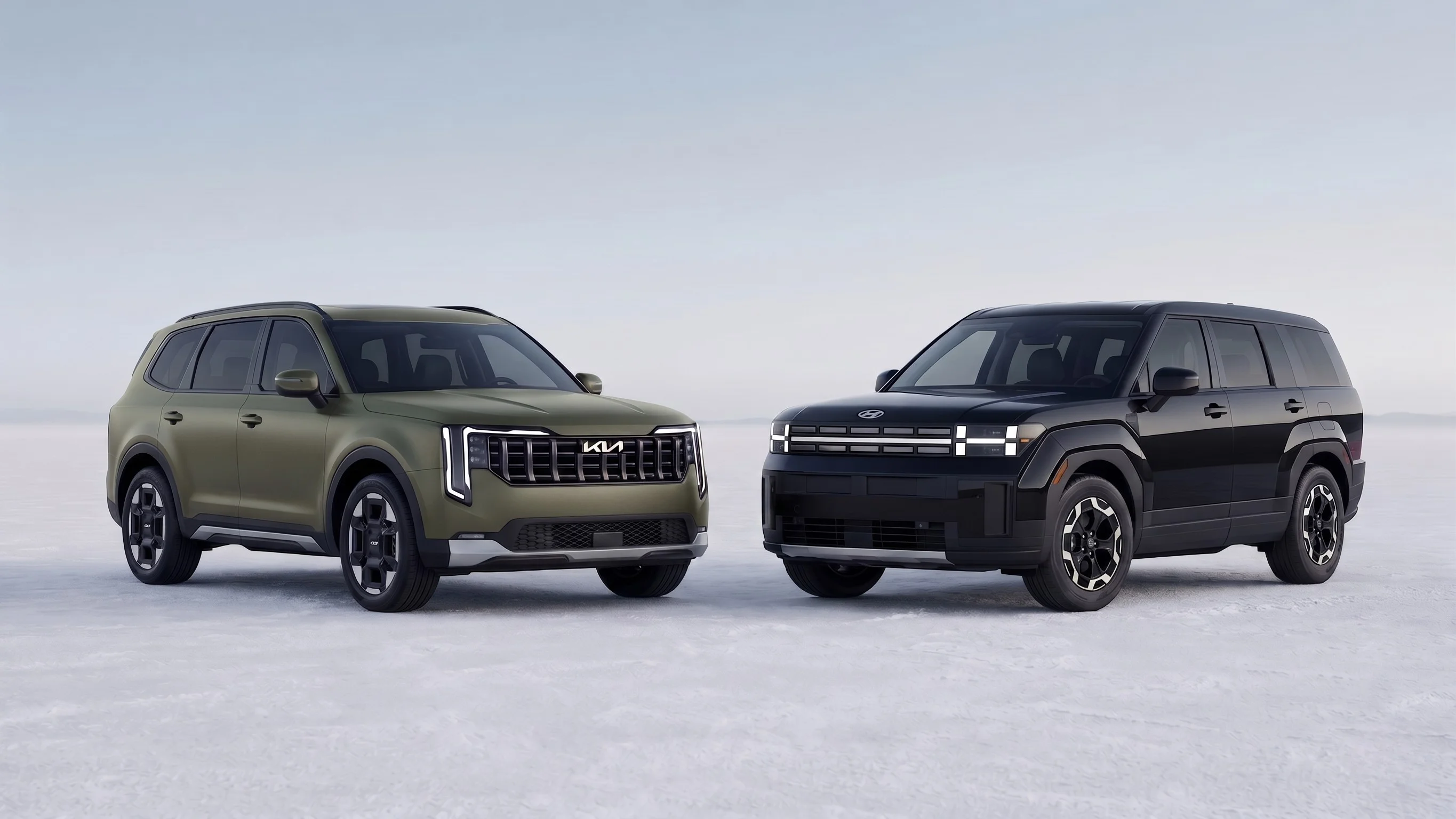
Hyundai and Kia Share an Owner but Operate as Separate Companies
The relationship dates to 1998. Kia went bankrupt during the Asian financial crisis, and Hyundai won a controlling stake at a creditor-supervised auction. Both companies now sit under Hyundai Motor Group governance. Each still trades separately on the Korea Exchange, with its own balance sheet and board. That structure lets them share the cost of big engineering programs, from EV platforms to driver-assist computing. It also lets each brand keep its own look and driving character.
Because both draw from the same engineering pool, equivalent models share structural foundations and mechanical hardware. The Hyundai Sonata and Kia K5 use the same 2.5-liter GDI four-cylinder. It makes 191 horsepower and 181 lb-ft of torque. Compact crossovers like the Hyundai Tucson and Kia Sportage share a platform, powertrain, and transmission.
For drivers comparing new vehicles in Ontario, that shared engineering explains a lot. OREMOR Automotive Group carries Hyundai across its Southern California rooftops. Both lineups deliver similar baseline capability, but they look very different, and knowing where the two brands actually diverge is the fastest way to pick one. Still deciding at the brand level? Our guide to which car brand fits your needs covers a wider field.
Reliability Records and Warranty Terms Are Effectively Identical
Warranty Coverage at a Glance
Both brands carry identical baseline warranty terms. Each provides a 10-year/100,000-mile powertrain warranty plus a 5-year/60,000-mile bumper-to-bumper warranty. That is among the most comprehensive coverage in the mainstream market. One catch applies to both: the 10-year powertrain term covers the original owner only. Later owners get the remaining 5-year/60,000-mile coverage.
| Coverage or Metric | Hyundai | Kia |
|---|---|---|
| Powertrain Limited Warranty | 10 years / 100,000 miles (original owner) | 10 years / 100,000 miles (original owner) |
| Bumper-to-Bumper Warranty | 5 years / 60,000 miles | 5 years / 60,000 miles |
| Hybrid & EV Battery Warranty | 10 years / 100,000 miles | 10 years / 100,000 miles |
| Complimentary Scheduled Maintenance (2026 and newer) | Not included | Not included |
| RepairPal Reliability Rating | 4.0 out of 5.0 | 4.0 out of 5.0 |
| RepairPal Brand Rank | 4th of 32 brands | 3rd of 32 brands |
| Average Annual Repair Cost | $468 | $474 |
Reliability Ratings and Repair Costs
RepairPal builds its ratings from real repair frequency, severity, and cost data. It gives both brands a 4.0 out of 5.0, ranking Hyundai fourth and Kia third among 32 brands. Average annual repair costs are effectively tied: $468 for Hyundai, $474 for Kia. Major components such as engine blocks, transmission cases, and hybrid drive units come from shared manufacturing.
What Changed for 2026: Complimentary Maintenance
One area where the two brands used to differ no longer does. Hyundai’s Complimentary Maintenance program covered scheduled oil changes and tire rotations for three years or 36,000 miles. It ended with the 2026 model year, effective March 27, 2025. Owners of 2020 through 2025 Hyundai vehicles keep their existing coverage. Kia has not offered a comparable national plan. So for 2026 and newer vehicles, neither brand includes free scheduled maintenance. Both now point buyers toward dealer prepaid maintenance instead.
Both brands back their hybrid and electric vehicle battery systems under a 10-year/100,000-mile battery and EV system warranty.
This information is provided for general educational purposes only and does not constitute legal advice. Warranty coverage depends on the specific terms of your vehicle’s warranty agreement. Consult your owner’s manual or a qualified legal professional for guidance on your individual situation.
Pricing and Five-Year Ownership Costs Stay Close Across Matching Trims
Hyundai tends to price its entry trims slightly above the equivalent Kia, and the gap narrows as you move up the range. Across matching segments, Kia leads on entry price, and fully optioned models land close together.
Configuration drives more of that gap than brand strategy does. Both brands now offer their compact hybrid crossovers with front- or all-wheel drive, and Hyundai added front-drive Tucson Hybrid trims during the 2026 model year. Because drivetrain availability and trim structure can shift mid-year, compare the exact configurations side by side rather than relying on a brand-level rule.
Projected five-year ownership costs between the two manufacturers remain tight. Factors influencing those calculations include:
- Initial purchase price and optional equipment packages
- Fuel consumption across matching powertrain options
- Scheduled maintenance intervals and wear-item replacement costs
- Estimated residual values and projected depreciation rates
Fuel Economy Across Matching Powertrains
Both lineups share engine designs and transmission hardware, so EPA-estimated fuel economy tracks closely within matching drivetrains. The hybrids are the exception worth checking. EPA-estimated combined figures vary by trim and drivetrain, and front-drive hybrid configurations rate higher than all-wheel-drive ones. Check the EPA-estimated rating for the exact configuration you want instead of assuming parity. Trim choice and driving habits shape long-term costs far more than the badge does. Weighing electrified options? Compare the tradeoffs in our overview of hybrid vs. electric vs. gas powertrains.
EPA-estimated fuel economy figures are for comparison purposes only. Your actual mileage will vary depending on driving conditions, how you drive and maintain your vehicle, battery age/condition, and other factors.
Hyundai and Kia Cabins Differ in Design Language, Not in Hardware
Hyundai favors a streamlined cabin with muted tones. Kia goes driver-centric, with sportier accents and high-contrast displays. Both use comparable infotainment hardware, including available dual 12.3-inch screens that pair a digital gauge cluster with a central touchscreen.
Hyundai interiors lean on horizontal dashboard lines, hidden vents, and push-button or rotary shift-by-wire controls. The effect is open and uncluttered. Materials often include soft-touch door panels, brushed metallic accents, and available leatherette or textile seats.
Kia takes a more technical approach. Center consoles angle toward the driver, and multi-mode touch panels toggle between climate and audio. GT-Line trims add contoured sport seats, D-shaped steering wheels, metallic pedal accents, and ambient lighting.
Both brands offer a closely matched set of connectivity features:
Wireless Apple CarPlay and Android Auto
Wireless smartphone integration is offered across both lineups.
Digital Key Smartphone Entry
Digital Key smartphone entry and remote engine starting are available on both brands.
Available Premium Audio
Premium Bose and Harman Kardon systems are available depending on the model.
Multi-Device Bluetooth Pairing
Both infotainment systems support pairing more than one phone at a time.
Driver Assistance: SmartSense vs. Drive Wise
Driver-assistance technology runs closely parallel across both lineups. Hyundai brands its suite SmartSense; Kia calls its equivalent Drive Wise. Core systems such as Forward Collision-Avoidance Assist and Lane Keeping Assist are standard on both. More advanced features are not. Blind-Spot View Monitor and Highway Driving Assist are trim-dependent on both brands, so check the equipment list on the trim you want.
Driver-assistance and advanced safety systems are supplemental aids and are not substitutes for safe and attentive driving. Availability, operation, and effectiveness vary by trim and equipment and depend on factors including road, weather, traffic, and vehicle condition. Always keep your hands on the wheel and your eyes on the road. See your owner’s manual for system limitations and details.
Hyundai and Kia Draw From the Same Engine Family With Different Tuning
Hyundai builds for compliant ride comfort, then goes hard with its N division. Kia tunes a firmer baseline suspension across standard trims and adds GT and GT-Line variants on top. Both draw from the same Hyundai Motor Group engine family, spanning turbocharged gas, hybrid, and fully electric powertrains.
Shared Engine Lineup
Standard powertrains on both lines are four-cylinders built for commuting, paired with automatic or continuously variable transmissions. Several engines appear in both brands’ vehicles with identical output.
| Engine | Horsepower | Torque | Example Models |
|---|---|---|---|
| 2.5L GDI four-cylinder | 191 hp | 181 lb-ft | Hyundai Sonata, Kia K5 |
| 1.6L turbocharged four-cylinder | 190 hp | 195 lb-ft | Kia K4 GT-Line Turbo |
| 2.5L turbocharged four-cylinder | 290 hp | 311 lb-ft | Hyundai Sonata N Line, Kia K5 GT |
Performance Sub-Brands
The structural difference in performance tuning becomes clearer at the top of each lineup:
- Hyundai N Division: Track-focused variants including the Elantra N and IONIQ 5 N add electronic limited-slip differentials, adaptive suspension dampers, and reinforced chassis bracing.
- Kia GT and GT-Line: Kia’s performance variants emphasize straight-line acceleration and firm body control, with the K5 GT pairing its 290-horsepower turbocharged four to an eight-speed dual-clutch transmission and a sport-tuned suspension.
Suspension Tuning
Suspension calibration reflects different goals. Hyundai specifies softer damping and more compliant bushings to absorb road imperfections. The payoff is a quieter ride over rough pavement on long drives. Kia tunes springs and dampers for firmer body control and flatter cornering, which suits drivers who want immediate steering feedback. If you like this format, try our Toyota vs. Nissan comparison.
Common Buyer Questions About Hyundai vs Kia
Does Hyundai or Kia offer a better factory warranty?
Both manufacturers provide matching baseline protection consisting of a 10-year/100,000-mile powertrain warranty and a 5-year/60,000-mile bumper-to-bumper warranty, with the powertrain term applying to the original owner. Neither brand includes complimentary scheduled maintenance on 2026 and newer vehicles. Hyundai’s Complimentary Maintenance program ended with the 2026 model year, and Kia has not offered a standardized national equivalent.
Are engine parts interchangeable between Hyundai and Kia vehicles?
Equivalent models built on shared platforms use the same engine families and transmission hardware. The Hyundai Tucson and Kia Sportage share a platform, powertrain, and transmission, as do the Hyundai Sonata and Kia K5. Whether a specific component carries across brands depends on the individual part, so confirm fitment by part number rather than assuming cross-brand compatibility.
Which brand earns better safety ratings from crash testing agencies?
Both brands perform well, and Hyundai holds a measurable edge in the 2026 award cycle. Under the Insurance Institute for Highway Safety‘s stricter 2026 criteria, Hyundai has earned eight awards: TOP SAFETY PICK+ for the IONIQ 5, IONIQ 9, Kona, Palisade, Santa Fe, Sonata, and Tucson, plus TOP SAFETY PICK for the Elantra. Kia has earned five TOP SAFETY PICK+ awards, for the EV9, K4, Sorento, Sportage, and Telluride. Some of these awards apply only to vehicles built after a specified date, so confirm the build date on the specific vehicle you are considering.
| Brand | 2026 TOP SAFETY PICK+ | 2026 TOP SAFETY PICK | Total 2026 Awards |
|---|---|---|---|
| Hyundai | 7 | 1 | 8 |
| Kia | 5 | 0 | 5 |
Do Hyundai and Kia electric vehicles share battery charging architecture?
Yes. Electric vehicles from both brands built on the shared Electric-Global Modular Platform use an 800-volt architecture that supports ultra-fast charging. Connected to a 350-kW DC fast charger, compatible models from either brand can charge from 10 percent to 80 percent in approximately 18 minutes under optimal conditions.
Is routine service and maintenance more expensive for a Hyundai or a Kia?
Independent repair data puts the two effectively level. RepairPal reports average annual repair costs of $468 for Hyundai and $474 for Kia, a difference of roughly $6 per year. Scheduled maintenance intervals and fluid requirements align across equivalent engine options, so routine service expense stays close to indistinguishable over a five-year ownership window.
Choosing Between Hyundai and Kia Comes Down to Style and Ride Feel
Choosing between Hyundai and Kia comes down to styling, cabin layout, and suspension tuning. It is not a gap in mechanical quality. Buyers who want cleaner lines, softer ride isolation, and the stronger safety record will prefer Hyundai. Drivers drawn to bold body contours, a driver-focused cockpit, and firmer suspension feedback tend toward Kia. Hyundai has taken eight IIHS awards in the 2026 cycle against Kia’s five, under the toughest criteria the institute has applied.
Both automakers share platforms, hybrid powertrains, and identical warranty terms. Either brand is a defensible choice on value and durability. The most reliable way to decide is still a test drive on the roads you actually use: seat comfort, infotainment response, ride quality. Cross-shopping beyond these two? Start with our roundup of the best car brands for families.
OREMOR Automotive Group carries Hyundai alongside 13 other brands across 18 dealerships in Southern California and Texas. To compare Hyundai models in person or arrange a test drive, call (909) 323-0539 or visit our Ontario location.
Disclaimers
EPA-estimated fuel economy figures are for comparison purposes only. Your actual mileage will vary depending on driving conditions, how you drive and maintain your vehicle, battery age/condition, and other factors.
This information is provided for general educational purposes only and does not constitute legal advice. Warranty coverage depends on the specific terms of your vehicle’s warranty agreement. Consult your owner’s manual or a qualified legal professional for guidance on your individual situation.
Driver-assistance and advanced safety systems are supplemental aids and are not substitutes for safe and attentive driving. Availability, operation, and effectiveness vary by trim and equipment and depend on factors including road, weather, traffic, and vehicle condition. Always keep your hands on the wheel and your eyes on the road. See your owner’s manual for system limitations and details.




0 comment(s) so far on Hyundai vs Kia: Reliability, Value, and Features Compared